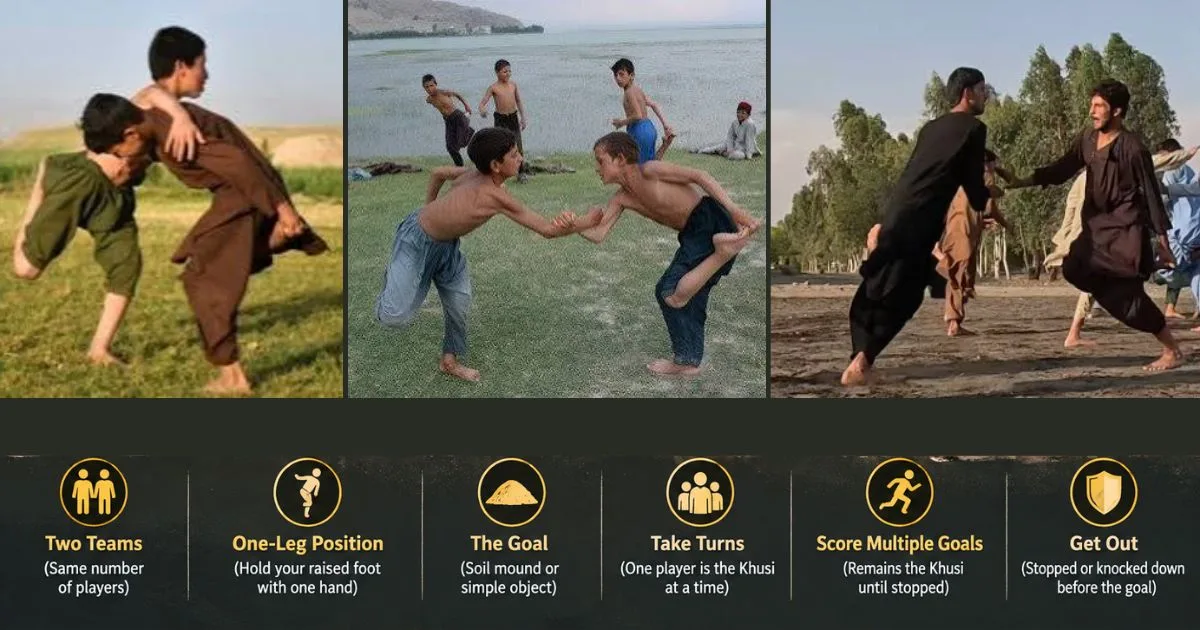
Khusi, also commonly written as Khusay or Khusai, is a traditional physical team game known in parts of Afghanistan and among Pashtun communities.
In Pashto, the game is known as د خوسي لوبه (Da Khusi Loba). The Afghan Ministry of Education has used this name in Pashto educational material.
Khusi is a highly physical game that combines one-leg movement, balance, speed, stamina, strength, agility, physical contact, teamwork, strategy, chasing, and goal scoring.
The game is not based only on physical strength. A strong player can be valuable, but a fast and agile player can sometimes defeat a stronger opponent by using speed, stamina, quick turns, and careful timing.
This article documents the traditional form of Khusi described through firsthand experience. Different communities and regions may have different names, rules, and playing methods.
1. The Basic Structure
Khusi is played between two teams. There is no fixed number of players. Depending on the group and the playing area, people could play:
- 1 vs. 1
- 2 vs. 2
- 3 vs. 3
- 5 vs. 5
- 6 vs. 6
- 10 vs. 10
- 12 vs. 12
The important general principle is that both teams have the same number of players. For example, a traditional match might be 5 vs. 5 or 6 vs. 6. Unequal teams such as 5 vs. 6 would normally not be used.
Before the game begins, all players stand normally on both feet. They do not remain on one leg before the start. When the players or organizer call “Start!”, the active game begins.
2. The One-Leg Position
Once the game starts, each player raises one leg and holds the raised foot with one hand. The player then moves and competes while standing on the other leg.
There is no fixed rule about which leg must be raised. A player may raise the right leg and stand on the left, or the left leg and stand on the right.
There is also no fixed rule about which hand must hold the raised foot. For example, a player may hold the raised right foot with the right hand and use the left hand for physical contact. Another player may hold the same foot with the left hand and use the right hand. Players choose the position that feels comfortable and gives them better balance.
The fingers of the hand holding the foot are placed among the toes to keep a firm grip. The other hand remains free. That free hand is important for movement, defence, pushing, and physical competition.
3. The Goal
Traditional Khusi does not normally use a football-style goalpost and net. In the traditional form described here, the goal was usually marked by a small mound of soil placed on the defending team’s side of the playing area.
The Khusi scores a goal by reaching the mound and placing a foot on it. When the foot touches the mound, one goal is counted.
In informal games, if there was no suitable soil available to make a mound, players could use another simple object as a goal marker. For example, when playing as children, a plastic slipper or shoe could be placed on the defending side. Reaching it and putting a foot on it counted as a goal.
The soil mound and plastic slipper are examples from the traditional games described by the author. Other local or organized forms may have used different goal markers.
4. The Two Teams
At any moment, one team is the attacking/scoring team and the other team is the defending team.
The attacking team does not send all of its players toward the goal at the same time. Instead, its players become the Khusi one after another.
The defending team knows which player is currently the Khusi because the attacking team announces the player before the turn begins. For example, suppose the attacking team has Ahmad, Mahmood and Khan. The team may tell the defenders: “Khan is the Khusi.” Khan then becomes the active scorer.
5. What the Khusi Does
The Khusi’s main objective is to reach the opponent’s goal. However, the Khusi is not simply a runner.
The Khusi can also fight, defend himself, dodge opponents, change direction, and use speed or strength to get past defenders. The Khusi’s teammates can also engage and distract the defenders. This makes the game a combination of scoring and team combat.
6. A Khusi Can Score Multiple Goals
A Khusi does not have only one attempt. If Khan reaches the goal and scores, he remains the Khusi. He can return and try to score again. For example: Khan scores once. Khan scores a second time. Khan scores a third time. Khan continues as the Khusi until he is eliminated.
Therefore, one highly skilled Khusi can score several goals during a single turn.
7. When the Khusi Is Out
A Khusi remains active until the defending team successfully stops him. In the traditional form described here, the important way of eliminating the Khusi is for a defender to stop or knock him down before he reaches the goal.
Once the Khusi is out, his turn ends. The attacking team then announces its next Khusi. For example:
- Khan becomes Khusi.
- Khan scores three goals.
- A defender stops Khan before his next goal.
- Khan is out.
- The attacking team announces Ahmad as the next Khusi.
- Ahmad continues until he is eliminated.
- Mahmood then becomes the Khusi.
This process continues until all players on the attacking team have completed their Khusi turns.
8. The Complete Scoring System
The total score of the team is counted after all of its players have completed their Khusi turns. For example, suppose there are two teams of six players.
Team A attacks first. Each of Team A’s six players becomes Khusi in turn. One player might score 3 goals. Another might score 1. Another might score 0. Another might score 4. The individual scores are added together. Suppose Team A finishes with 12 goals.
Now the teams change sides. Team B becomes the attacking team, while Team A becomes the defending team. Team B now gives each of its players a Khusi turn. Team B tries to score more than Team A’s 12 goals. The result is:
- 13 or more goals: Team B wins.
- 12 goals: Draw.
- 11 or fewer goals: Team B loses.
This system gives both teams an equal opportunity to attack and defend.
9. Teamwork and Protecting the Khusi
The Khusi does not normally move alone. The Khusi’s teammates can protect and support him. For example, imagine five active players on each side. One player is the Khusi. The Khusi’s four teammates can engage the defenders while the Khusi moves toward the goal.
The defending team then has a choice. They can continue fighting the other players, or they can leave that engagement and chase the Khusi. This creates an important tactical problem. If the defenders leave their opponents to chase the Khusi, the Khusi’s teammates may become free. If they continue fighting the teammates, the Khusi may get a clear route to the goal.
10. Choosing Which Defender to Engage
Another important strategy is to compare the strengths of the defenders. Suppose there are five players on each side and one player is the Khusi. The attacking team may look at the five defenders and identify the player who appears to be relatively weaker than the others.
Instead of trying to fight all five defenders equally, the Khusi’s teammates can engage the four stronger defenders. The relatively weaker defender is left to deal with the Khusi. The idea is simple: keep the stronger defenders busy and give the Khusi a more manageable opponent.
If the weaker defender attacks the Khusi, the Khusi may be able to beat that player through speed, strength, agility, or technique and reach the goal. This shows that players were not only thinking about their own strength. They were also studying the relative strengths and weaknesses of the opposing team.
11. The Khusi Is Not a Passive Player
The Khusi can fight. If the Khusi’s teammates are all eliminated while several defenders remain, the Khusi may still continue playing. A strong or highly skilled Khusi may be able to fight, dodge, and move past several defenders.
A fast Khusi may use a completely different strategy. Instead of fighting, the Khusi may keep running and changing direction until the defenders become tired or lose their position. This creates the possibility of a dramatic comeback by a single player.
12. Strength Versus Speed
One of the most interesting parts of Khusi is the difference between strength and speed. Some teams preferred very fast players for Khusi because they could escape defenders and reach the goal quickly. A fast player did not necessarily have to be physically powerful.
Imagine that only one Khusi and one defender remain. The Khusi is smaller and faster. The defender is much stronger. The Khusi may avoid direct fighting. Instead, he can make the defender chase him. The defender may become tired from repeated chasing. When the right moment comes, the Khusi can suddenly change direction and accelerate toward the goal. In this way, speed and stamina can sometimes overcome physical strength.
However, fast players were not the only possible Khusi players. A strong player could also become Khusi and use strength and fighting ability. Different teams could use different types of players depending on their strengths.
13. Speed and Movement on One Leg
Although the game is played on one leg, experienced players can move very quickly. Players can:
- chase opponents,
- escape from defenders,
- move toward the goal,
- change direction,
- stop and accelerate,
- turn quickly,
- and dodge attacks.
A skilled player can move around an opponent in a way that is somewhat similar to a football player dribbling around a defender. The difference is that Khusi players perform these movements while maintaining the one-leg position.
The author’s firsthand experience suggests that highly experienced players could move very fast on one leg, even over considerable distances. This is a personal observation rather than a scientifically measured performance record.
14. Dodging and Using Momentum
A player does not always need to meet an opponent directly. For example, a defender may run toward the Khusi at high speed to push him. The Khusi can wait until the last moment and suddenly move to the side. The defender’s momentum may carry him forward and cause him to lose balance.
This makes several skills important: timing, reaction speed, balance, prediction, and quick direction changes. The same idea can be used by defenders against attacking players.
15. Physical Contact
Khusi is a physical contact game. Players can push, grab, chase, block, and physically compete while maintaining the one-leg position. One basic physical action is a push using the free hand. A player can push an opponent in the upper body. A strong or well-timed push can make the opponent lose balance and fall.
Players also have to protect the hand that holds their raised foot. An opponent may try to interfere with that grip and force the player to release the foot. If the required grip is lost, the player may be considered out, depending on the local version.
16. The Raised Knee
Because the raised leg is held in the hand, the knee naturally points forward. In some local forms of Khusi, the knee could also be used during physical competition. This was not necessarily treated as a foul in every local version. However, it could make the game dangerous.
The author remembers safer childhood forms in which players avoided dangerous knee attacks because of the possibility of injury. This is another example of why local rules and playing styles should not be assumed to be identical everywhere.
17. Powerful Physical Moves
Traditional players could use body position, balance, and strength to throw an opponent off balance. Some forms included powerful movements involving the raised knee and upper-body control that could lift or throw an opponent.
These actions could cause serious injury in real life and should not be copied without proper training and safety. For a digital game, such actions could instead be represented as a signature move, power takedown, or knockdown animation.
18. Jump and Dash Attacks
Another movement described in traditional play involved approaching an opponent very quickly and using a jump or leap with body momentum to push the opponent backward. This type of movement could be especially effective when a player had good speed and timing.
In a digital version, it could become a special ability such as a Dash Push or Leap Attack.
19. Stamina and Endurance
Khusi requires much more than balance. A good player needs:
- balance,
- speed,
- agility,
- strength,
- stamina,
- endurance,
- reaction time,
- timing,
- body control,
- physical skill,
- and strategic thinking.
Stamina is especially important because players may need to remain active on one leg while running, chasing, fighting, defending, escaping, and trying to score. A very strong player who becomes tired quickly may struggle against a lighter player with greater endurance. Therefore, stamina is one of the core abilities in Khusi.
20. Different Types of Players
A team does not need every player to have the same ability. Different players can have different roles and strengths.
- Strong Player — Useful in direct physical competition.
- Fast Player — Useful for escaping defenders and reaching the goal quickly.
- Agile Player — Good at changing direction and avoiding attacks.
- Endurance Player — Can continue moving and competing for a long time.
- Balanced Player — Can perform reasonably well in several areas.
Some teams may have one particularly fast player who is often expected to score more goals when given the Khusi role. However, the Khusi role is not permanently reserved for that player. Other teammates can become Khusi during their turns.
21. Strategy Is Central to the Game
Khusi is not simply a test of physical strength. Players constantly make decisions. Should they:
- attack the Khusi?
- fight the Khusi’s teammates?
- protect their own players?
- chase a fast Khusi?
- make the Khusi tired?
- keep strong defenders occupied?
- leave a weaker defender against the Khusi?
- fight directly?
- use speed and dodging?
- create a path toward the goal?
These decisions can change the result of a turn. A team with strong players may still have problems if it uses poor strategy. Likewise, a team with a very fast or agile Khusi can create opportunities even against physically stronger opponents.
22. Traditional Clothing
Khusi did not have a special uniform. In the traditional games described by the author, players often removed their loose outer shirt before playing. Some played wearing a vest or undershirt. Players also commonly tightened their shalwar before the game.
This was mainly practical. Traditional Pashtun clothing can be loose, and loose clothing could get in the way during fast movement, grabbing, pushing, and physical contact. This was not an official dress code. It was simply how players prepared themselves for the game.
23. Children and Adults
Khusi was not only a children’s game. Young men and adults also played it. The game could be played casually or in well-organized local matches. There were generally no professional clubs, national teams, or standardized training systems associated with the traditional form described here. People normally learned by watching others play and then joining the game. Knowledge of the game was therefore passed through direct experience and community participation.
24. Simple Equipment
One of the most accessible features of Khusi was that it required very little equipment. Players did not need:
- expensive sports equipment,
- a special uniform,
- a football,
- a net,
- or a professional stadium.
An open area could be enough. A small mound of soil could mark the goal. If there was no suitable soil, a plastic slipper or shoe could serve as a simple goal marker. The players themselves provided most of the action.
25. Regional Names and Variations
The Pashto name د خوسي لوبه (Da Khusi Loba) is used for the game. The English spelling may appear in different forms, including Khusi, Khusay, or Khusai, because Pashto words can be transliterated into English in different ways.
Traditional games can also have different names and rules in different regions. Other Afghan cultural sources describe related or regionally different one-leg physical games. Therefore, Khusi should not be presented as having one identical rulebook across all of Afghanistan. This article documents a traditional form based mainly on firsthand experience while recognizing that other communities may have their own versions.
26. Khusi as a Cultural Memory
For people who grew up playing or watching Khusi, the game was part of community life. People could gather in an open area, divide themselves into equal teams, prepare a simple goal marker, and begin playing. A mound of soil could become a goal. A plastic slipper could become a goal when no mound was available. A loose traditional shirt could simply be removed. No expensive equipment was necessary. This simplicity made the game accessible to ordinary communities.
27. The Decline of Traditional Khusi
Traditional games can become less common when modern sports and forms of entertainment become more popular. Football and cricket became increasingly visible and organized, while children also gained access to television, smartphones, video games, and other entertainment. As a result, some traditional games that were once common became difficult to find. In some communities, younger generations may know little about Khusi. Recording the rules and memories of the game can therefore help preserve knowledge about it.
28. Khusi as a Digital Game
The traditional game also has interesting possibilities as a mobile or computer game. Its basic structure already contains many elements that can work well digitally: teams, one-leg movement, speed, stamina, physical competition, goal scoring, player roles, teamwork, chasing, defence, strategy, and different player abilities.
Players could have different statistics such as:
- Speed
- Strength
- Balance
- Stamina
- Agility
- Power
- Defence
A fast player could escape a stronger defender. A strong player could perform better in direct physical competition. A high-stamina player could keep moving longer. An agile player could make sharper turns. A balanced player could perform well in several areas.
29. A Digital Match Based on the Traditional System
A digital version could preserve the traditional scoring structure. For example: Team A vs. Team B. Team A attacks first. Team A selects or announces its first Khusi. The Khusi can score repeatedly until eliminated. When that Khusi is out, the next Team A player becomes Khusi. This continues until all Team A players have completed their Khusi turns.
Suppose Team A scores 12 goals. The sides then change. Team B attacks. Team B must try to score more than 12. If Team B scores 13, it wins. If Team B scores 12, the result is a draw. If Team B scores less than 12, it loses. This preserves the basic competitive structure of the traditional game.
30. Why a Digital Version Could Be Interesting
A digital Khusi game should not feel like a slow fighting game. The one-leg movement should remain fast, responsive, and athletic. Players should be able to: run, turn, dodge, chase, escape, fight, protect teammates, target weaker defenders, create openings, and make quick strategic decisions.
The strongest player should not automatically be the best player. A fast player should be able to beat a stronger opponent through movement. A strong player should be able to stop a fast player if the timing is right. This creates a natural balance between strength, speed, stamina, and strategy.
31. Preserving Khusi for Future Generations
Traditional games are part of cultural history. Even if Khusi is no longer widely played in some communities, recording its rules, names, playing methods, memories, and regional variations can help preserve it. Future documentation could include:
- photographs,
- interviews with older players,
- videos of traditional play,
- regional names,
- local rules,
- personal memories,
- and historical references.
Collecting accounts from different regions would also help researchers understand how the game changed from one community to another.
Conclusion
Khusi (Khusay) is a traditional Pashtun team game that combines one-leg movement, balance, speed, strength, stamina, agility, physical competition, teamwork, strategy, and goal scoring.
Its most distinctive feature is the Khusi player, who remains active and can score repeatedly until being eliminated. The attacking team’s players become Khusi one after another. Each Khusi continues playing until being stopped. After all the players of the attacking team have completed their turns, their total goals are counted. The teams then change sides, giving the other team the same opportunity to attack.
The traditional goal can be as simple as a small mound of soil. In informal games, a plastic slipper or shoe could also serve as a goal marker. The game did not require a special uniform, expensive equipment, or a professional field. Its players could be children, young men, or adults.
Its most interesting qualities were not only physical strength, but also speed, endurance, balance, timing, teamwork, and strategy. A fast Khusi could outmaneuver a strong defender. Teammates could keep strong defenders busy while leaving a weaker defender to face the Khusi. A strong Khusi could fight his way toward the goal. A skilled player could continue even when his teammates were out.
These features make Khusi more than a simple traditional game. They make it a distinctive part of Pashtun physical culture and a potentially interesting subject for cultural documentation and future digital game development. Documenting Khusi today can help preserve the memory of a traditional game that may otherwise become difficult for future generations to understand or experience.